
New York Arrest Records
New York arrest records are held by law enforcement agencies, courts, and state offices across all 62 counties. You can search for arrest records through the state court system, county sheriff offices, and police departments that made the arrest. The Division of Criminal Justice Services keeps the official state rap sheet for each person with a criminal history in New York. County clerks also hold court records tied to arrests and criminal cases. Whether you need to look up a case, find booking details, or get a copy of an arrest report, New York has several ways to search at both the state and local level.
New York Arrest Records Overview
Where to Find New York Arrest Records
Arrest records in New York are kept in more than one place. The agency that made the arrest holds a copy. The court that handled the case keeps its own file. And the state keeps a central record at DCJS in Albany. So there is no single spot where all arrest records sit. You may need to check more than one source, depending on what you are looking for and where the arrest took place.
The Division of Criminal Justice Services is the only source of official New York State criminal history records. DCJS keeps a fingerprint-based database of all arrests reported by police departments, district attorneys, and courts across the state. No other agency or third party can give you the official state record. To get your own rap sheet, you must submit fingerprints through an authorized IdentoGO location. The fee runs about $50 to $65 depending on service level. Results come by mail in 7 to 10 business days. DCJS records cannot be obtained through FOIL, and third-party background check companies cannot access official DCJS records either.
At the county level, sheriff offices and police departments hold arrest reports and booking records. Each of New York's 62 counties has a sheriff's office that responds to FOIL requests for these records. The County Clerk in each county also maintains court records tied to criminal cases, including certificates of disposition that show how a case ended.
Note: DCJS is the only source for official New York rap sheets. County sheriff offices and clerks hold local arrest reports and court case files.
How to Search Arrest Records in New York
The Office of Court Administration runs a statewide Criminal History Record Search, or CHRS. This is a name-based search that costs $95 per lookup. It covers open cases and convictions from all 62 counties. You can submit a search through the online Direct Access program or by mail. The search uses an exact match on name and date of birth. If the name or DOB in the court record is even a little different from what you type in, the record will not come up. CHRS results are not certified and should not be confused with a certificate of disposition from the court.
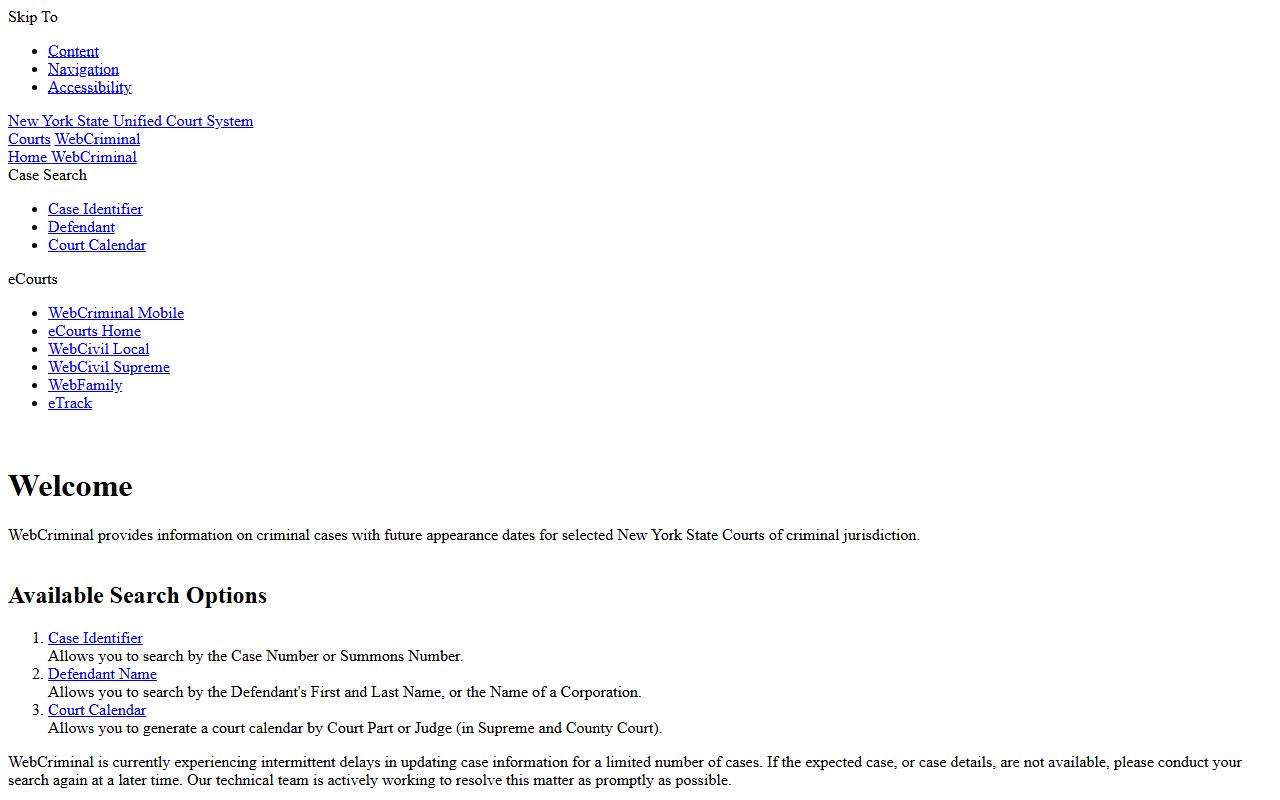
For pending criminal cases, WebCrims is a free tool that shows future court dates. Anyone can log in as a guest. You can search by name or docket number to find upcoming appearances. WebCrims does not show closed cases, bench warrants, or arrest warrants. It only covers cases with scheduled future dates.
The DOCCS Inmate Lookup lets you search for people in state prison. You can search by last name and birth year, or by DIN number. The data is live and shows current custody status, charges, facility, and parole dates. This covers state facilities only. For local jails, contact the county sheriff.
To search locally, you can submit a FOIL request to the sheriff's office or police department that made the arrest. Under Public Officers Law Sections 84 through 90, agencies must respond within five business days. Most charge $0.25 per page for copies.
New York Arrest Records Search Tools
The DCJS record review page is the starting point for anyone who needs their official criminal history from the state. The page explains the fingerprint process and has details about the Clean Slate Act that took effect in November 2024.
DCJS processes record requests through IdentoGO locations across the state. Results come back as either an unsuppressed or suppressed response. The unsuppressed version includes sealed records under various CPL sections. The suppressed version leaves those out. If you need both, you must submit two separate requests and pay two fees.
The DOCCS inmate lookup tool below lets you search the state prison system in real time. It pulls data directly from the department's main database at the time of your search.
Search results show the person's name, date of birth, DIN, NYSID, custody status, facility, sentence information, and parole eligibility date. The system updates daily with a brief maintenance window at 11:45 PM. People convicted of violent felonies, sex offenses, or certain A-1 felonies stay in the system permanently. Others may be removed under Correction Law Section 9 five years after completing their sentence.
New York Arrest Records and the Law
Several state laws shape how arrest records work in New York. The Freedom of Information Law, set out in Article 6 of the Public Officers Law Sections 84 through 90, gives the public a right to access government records. This includes arrest reports held by police and sheriff offices. But there are limits. Records tied to open investigations can be held back. So can anything that would put someone's safety at risk or invade personal privacy.
In 2019, New York amended FOIL to create a presumption against releasing booking photographs unless there is a specific law enforcement reason. This change sits in Public Officers Law Section 89(2)(b). Before this, mugshots were often released as public records. Now agencies can deny those requests in most cases.
The Clean Slate Act took effect on November 16, 2024. This law gives the Office of Court Administration up to three years to build out processes for automatic sealing of eligible conviction records. Misdemeanors get sealed three years after sentencing. Felonies get sealed after eight years from completion of sentence. Sex offenses and Class A felonies are not eligible. Under CPL Section 160.50, arrests that end in dismissal, acquittal, or a non-criminal outcome should be sealed automatically without any application needed.
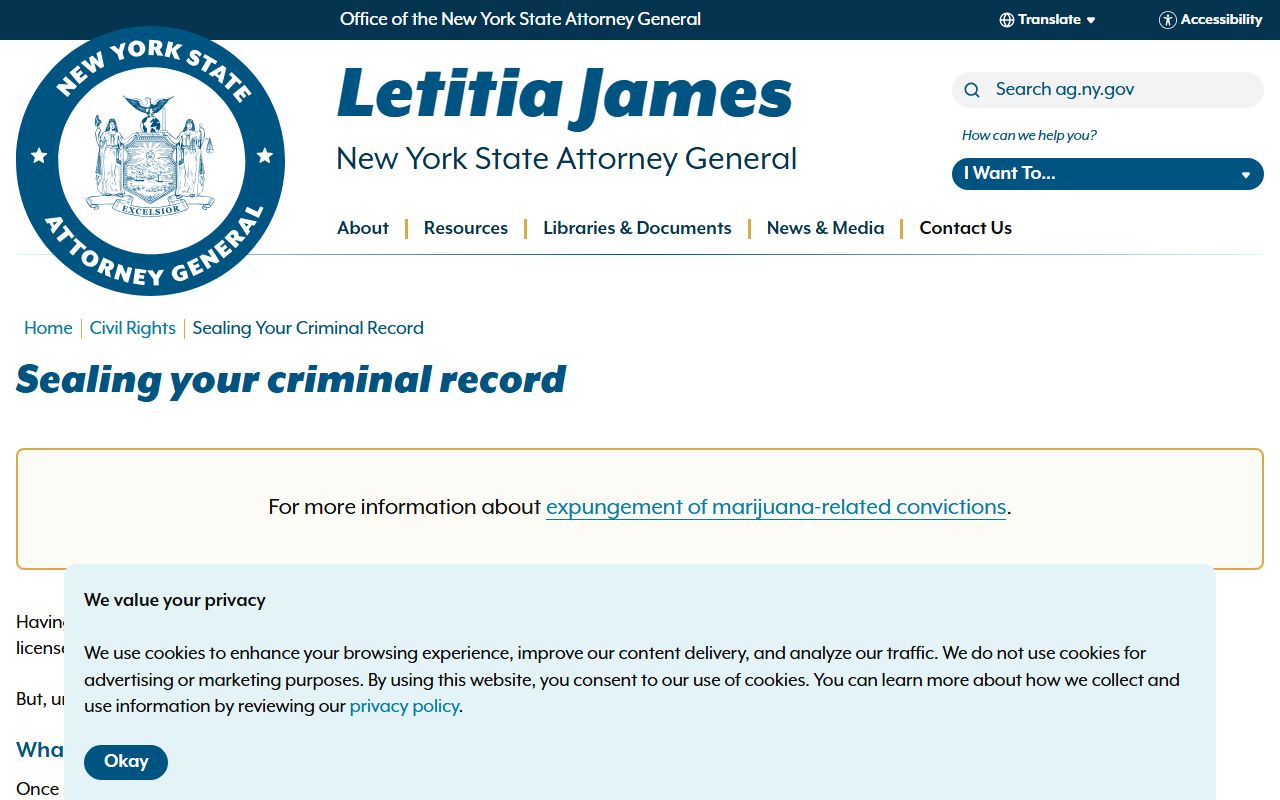
CPL Section 160.59 allows people to apply for sealing of certain convictions. You can have no more than two criminal convictions total and no more than one felony. At least 10 years must pass since your last sentence or release from incarceration. You cannot seal violent felonies, sex offenses, or Class A felonies. The Attorney General's website explains the full eligibility rules.
In 2020, the state legislature repealed Civil Rights Law Section 50-a. That old law had kept police disciplinary records hidden from the public under FOIL. After the repeal, misconduct allegations, use of force reports, and civilian complaints became accessible through records requests.
FOIL Requests for Arrest Records
FOIL is how you get arrest reports from local agencies. Submit your request in writing to the agency's Records Access Officer. Be specific. Include the person's name, the date or time frame, and any case or incident numbers you have. The agency must respond within five business days.
Standard copy fees are $0.25 per page for documents up to 9 by 14 inches. There is no charge for just looking at records in person. If the agency sends files by email, there is no copy fee either. Some requests that take more than two hours to prepare may have extra charges based on the hourly rate of the lowest-paid employee who can do the work.
If your request gets denied, you have 30 days to file an appeal. The appeal goes to the agency's FOIL appeals officer. Include a copy of your original request and the denial letter. Common reasons for denial include ongoing investigations, privacy concerns, and records protected by attorney-client privilege.
New York Sex Offender Registry
The Sex Offender Registry is a free search tool run by DCJS. It shows Level 2 and Level 3 offenders. Level 1 offenders are not listed online but may be available through local sheriff offices. You can search by name, county, ZIP code, or within a set distance of an address.
The registry is available online around the clock. You can also call 518-457-5837 or 1-800-262-3257 during business hours to ask about a specific offender. Results show the person's name, photo, risk level, address, conviction details, and vehicle information when available. Each county sheriff also keeps local sex offender data.
Arrest Records Through New York Courts
Every arrest that leads to a criminal case creates a court record. The NY CourtHelp site explains what your rap sheet contains and how to fix errors on it. Your rap sheet includes personal ID information, your full arrest history, prosecution data, court dispositions, sentencing, and correctional supervision history. "RAP" stands for Record of Arrest and Prosecution.
To correct arrest information on your record, contact the police agency that made the arrest. They must submit the changes to DCJS. For disposition corrections, get a certified copy of the disposition from the court and send it to the DCJS Records Correspondence Unit at 80 South Swan Street in Albany. You can also email dcjsCriminalJusticeRecords@dcjs.ny.gov or call 518-457-9847.
Marijuana convictions under Penal Law Sections 221.05 through 221.40 are now vacated, dismissed, sealed, and expunged under the Marijuana Regulation and Taxation Act. These records will not show up on any criminal history search. It is unlawful for anyone to ask about them.
Browse New York Arrest Records by County
Each of New York's 62 counties has its own sheriff's office and court system that handles arrest records. Pick a county below to find local contact info and resources.
Arrest Records in Major New York Cities
City residents go through their county's sheriff office or local police department for arrest records. Select a city below to find where to go and what to expect.